Phishing & Scams
The Silently Broken Boundary: How OAuth Token Hijacking Exploits Third Party Integrations
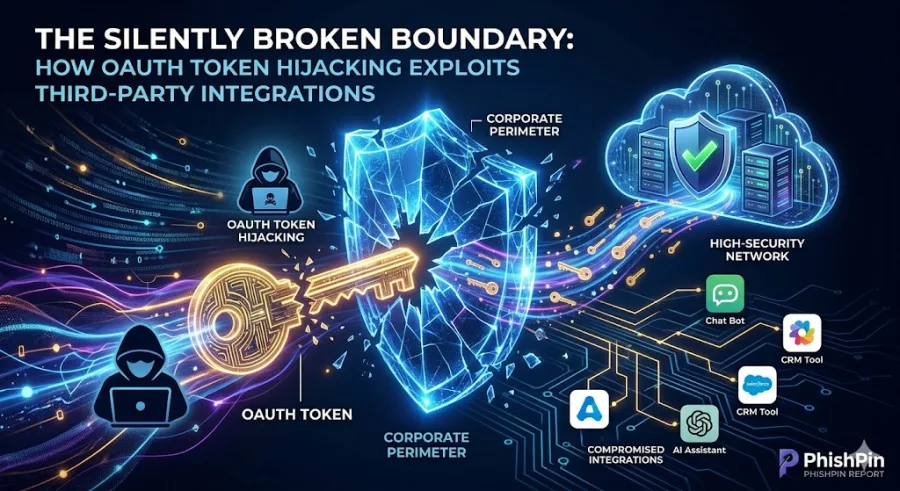
OAuth is the technology that allows you to click Log in with Google, Connect to Slack, or Authorize via Microsoft without revealing your actual corporate password.
But cybercriminals have discovered that they do not need to break into your guarded infrastructure if they can steal the digital keycard to a trusted vendor. Through a massive surge in OAuth Token Hijacking, threat actors are exploiting third party integrations to move laterally into high security corporate networks completely undetected.
What is OAuth Token Hijacking?
An OAuth token is a cryptographic string that acts like an infinite digital pass. Once an employee grants an external application permission to access their corporate environment, that application receives a token allowing it to interact with the network in the background.
OAuth Token Hijacking occurs when a cybercriminal either compromises the third party provider's servers directly or tricks an employee into approving a malicious, fake application. Once the attacker controls that token, they inherit all the permissions granted to that application. They can read emails, extract sensitive database schemas, and download corporate files without triggering a single password reset or multi factor authentication alarm.
Why Third Party Compromises Are Surging
Traditional corporate defenses are highly optimized to scan incoming files and block brute force login attempts. This shift to targeting APIs and integrations is highly deliberate for a few major reasons.
First, it creates the illusion of supplier trust. When an attacker uses a compromised, valid OAuth token from a well known B2B service, your security gateway sees a trusted, pre approved partner. It skips standard validation protocols because the connection has already been marked as safe.
Second, it allows persistent invisible access. Unlike temporary login sessions, OAuth tokens often remain valid for weeks, months, or indefinitely unless explicitly revoked by an administrator. This provides threat actors with a persistent foothold inside your data environment.
Third, it exploits the shadow integration trap. Employees routinely connect unverified third party utility tools, time management add ons, or generative AI assistants to their corporate accounts without notifying IT teams. This creates a massive, unmonitored blind spot across the enterprise.
Critical Red Flags of a Compromised Integration
Because token theft does not involve changing account credentials, identifying an ongoing attack requires analyzing application behavioral footprints rather than looking for wrong passwords.
Red Flag 1: Mass Permission Requests. This is an unexpected prompt asking an employee to grant an integrated application wide ranging, administrative permissions, such as the ability to read all mailbox items or modify tenant access.
Red Flag 2: Abnormal API Call Ingestion. This happens when corporate audit logs display a sudden, massive surge in data requests or system modifications occurring via an external application outside of normal business hours.
Red Flag 3: Mismatched App Authentication. This occurs when an application attempts to connect to your network from a geographic location or cloud hosting IP block that does not align with the vendor's verified server infrastructure.
The Integration Security Rule: Just because an application is convenient does not mean it is secure. Every external tool you authorize to read, write, or view your corporate environment introduces a completely unmanaged door into your system architecture.
Hardening Your Connected Ecosystem with PhishPin
Defending against modern supply chain identity fraud requires shifting from passive authorization to continuous behavioral observation.
You should immediately enforce the principle of least privilege. Audit all existing third party integrations and revoke any application tokens that demand broader access permissions than strictly necessary to perform their function.
Next, establish automated inventory controls. Implement strict identity policies that prevent standard employees from authorizing third party OAuth apps without formal cybersecurity team verification and sign off.
Finally, run modern identity threat simulations. Traditional security training programs focus entirely on fake links. Forward thinking organizations use PhishPin to run advanced simulations that train employees to recognize sophisticated application impersonation traps, ensuring they do not blindly click Authorize on a hostile asset.