Cyber Crime
The Death of Evidence: Surviving the Era of Deepfake Deception
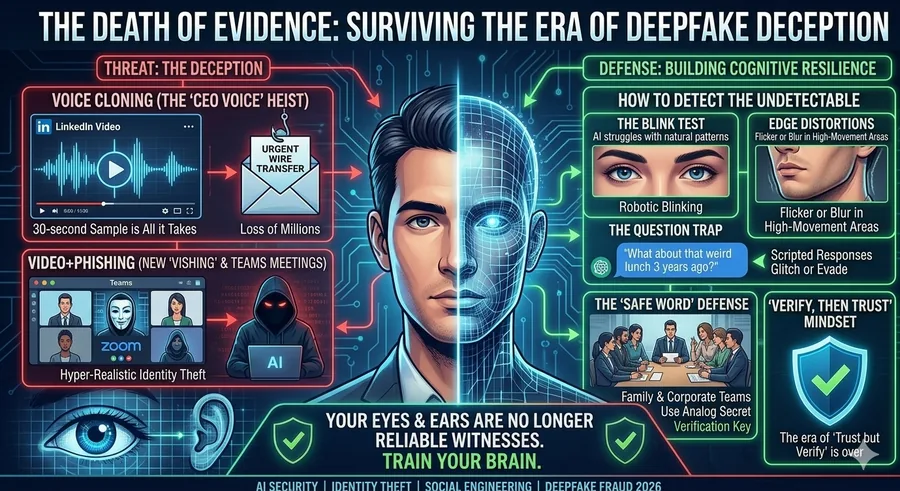
Just a few years ago, a "Deepfake" was a grainy, slightly glitchy video found in the corners of the internet. Today, they are sophisticated, real-time tools used to bypass biometric security, commit multi-million dollar corporate fraud, and ruin reputations in seconds. In the war for your data, the new front line isn't a password—it’s your identity.
The "CEO Voice" Heist
Imagine receiving a call from your manager on a Friday afternoon. You recognize the voice, the tone, and even the specific way they say your name. They ask you to authorize an urgent payment for a secret acquisition. You do it, only to find out Monday morning that your manager never called you.
This isn't a hypothetical movie plot. Companies are losing millions to Voice Cloning technology that requires less than 30 seconds of audio (often pulled from a YouTube interview or a LinkedIn video) to create a perfect, real-time vocal replica.
The New "Vishing": Video + Phishing
We are moving beyond the fake phone call. In 2026, attackers are joining Zoom and Microsoft Teams meetings using real-time video overlays. They look like a colleague, they move like a colleague, but they are a digital mask.
This "Hyper-Realistic Identity Theft" targets the one thing humans give away most freely: Trust. If we see a face we recognize, our critical thinking drops. Attackers are banking on that momentary lapse in judgment.
How to Detect the Undetectable
As AI gets better at mimicking humans, we must get better at spotting the "Digital Ghost" in the machine. Look for these subtle red flags:
The Blink Test: Many AI models still struggle with natural blinking patterns. If the person on the screen isn't blinking or the timing feels robotic, be wary.
Edge Distortions: Look closely at the jawline and the area where the hair meets the forehead. Deepfakes often "flicker" or blur in these high-movement areas.
The Question Trap: Deepfakes often rely on scripted responses. Ask an unexpected, non-sequitur question (e.g., "What did you think of that weird lunch we had three years ago?"). An AI might glitch or provide a generic "I'm busy, let's focus on the task" response.
The "Safe Word" Defense
In a world of digital clones, the most effective defense is surprisingly low-tech: The Analog Secret.
Families and corporate teams are now adopting "Safe Words"—a non-digital, unsearchable phrase used to verify identity during any high-stakes request. If the "CEO" on the screen can’t provide the secret word, the conversation ends immediately.
The Bottom Line
The era of "Trust but Verify" is over. We have entered the era of "Verify, then Trust." Technology has made it possible to clone a face and a voice, but it cannot yet clone the unique, shared history between two people. Use that to your advantage.