Phishing & Scams
Deconstructing Lookalike Domains: TLD Typosquatting Patterns in Modern Phishing Infrastructure
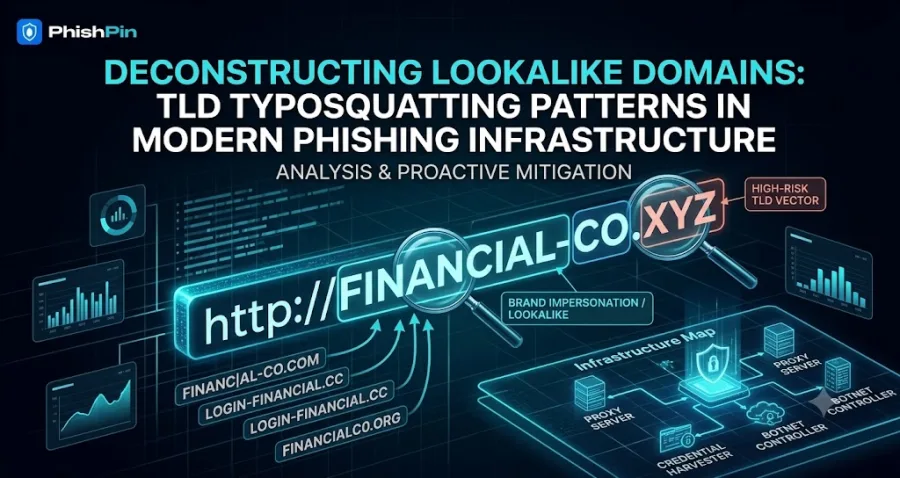
By cross-referencing global registrar data with real-time analytics from PhishPin’s NRD Intel (Newly Registered Domains) feed, we have isolated the top typosquatting permutations and top-level domain (TLD) variations threat actors use to bypass standard defensive layers.
The Anatomy of a Spoofed Domain
When attackers target an enterprise brand, they generally rely on four distinct structural mutations to trick both human eyes and basic signature-based email secure gateways (SEGs):
Character Substitution (Homoglyphs): Swapping visually identical characters from different alphabets (e.g., using the Cyrillic 'а' instead of the Latin 'a').
Combosquatting: Appending urgent corporate keywords to the real brand name (e.g., brand-security.com, login-brand.com, or brand-verify.net).
Typosquatting: Omitting letters or capitalizing on common keyboard typos (e.g., blandname.com or braandname.com).
TLD Arbitrage: Registering the exact corporate name across high-risk or cheap Top-Level Domains (like .xyz, .top, or .cc) instead of the legitimate .com.
[THREAT LANDSCAPE BREAKDOWN] 🛡️ (1) COMBOSQUATTING: Average Detection Rate: 42% | High-Risk Keywords: login, support, verify, secure | Common TLDs: .com, .net, .info 🛑 (2) TLD ARBITRAGE: Average Detection Rate: 28% | High-Risk Keywords: (Exact brand name match) | Common TLDs: .xyz, .top, .click, .co 🛑 (3) TYPOSQUATTING: Average Detection Rate: 18% | High-Risk Keywords: (Keyboard proximity mistakes) | Common TLDs: .com, .cn, .biz 🛑 (4) CHARACTER OMISSION: Average Detection Rate: 12% | High-Risk Keywords: (Missing double consonants) | Common TLDs: .org, .live
Proactive Mitigation: Leveraging NRD Intel
To reliably get ahead of these weaponized setups, security operation centers must track newly registered domains the moment they hit public DNS logs.
Using PhishPin’s BrandRadar AI, enterprises can establish custom regex alerts. If a domain matching your brand identity is registered anywhere globally, it is instantly funneled into the URL Sandbox for continuous observation. If the domain configures mail records (MX records) or builds a clone of your login portal, automated Enforcement workflows trigger an immediate takedown request before the site goes live to the public.